Media Literacy
Media literacy is a skill that is vital to the safety, security, health, and wellbeing of individuals and communities. Social media and other online applications are a part of everyday lives. Becoming media literate can reduce the risk of consuming harmful and misleading content online.
Media literacy addresses three types of online content:
- Misinformation: False information that is not created or shared with the intent of causing harm.
- Malinformation: Information based on fact but often used out of context to mislead, harm, or manipulate.
- Disinformation: Information deliberately created or shared to mislead, harm, or manipulate a person, social group, organization, or country.
See more information on how to identify if an image is true or believable below (Qian, Shen, Zhang, 2024):
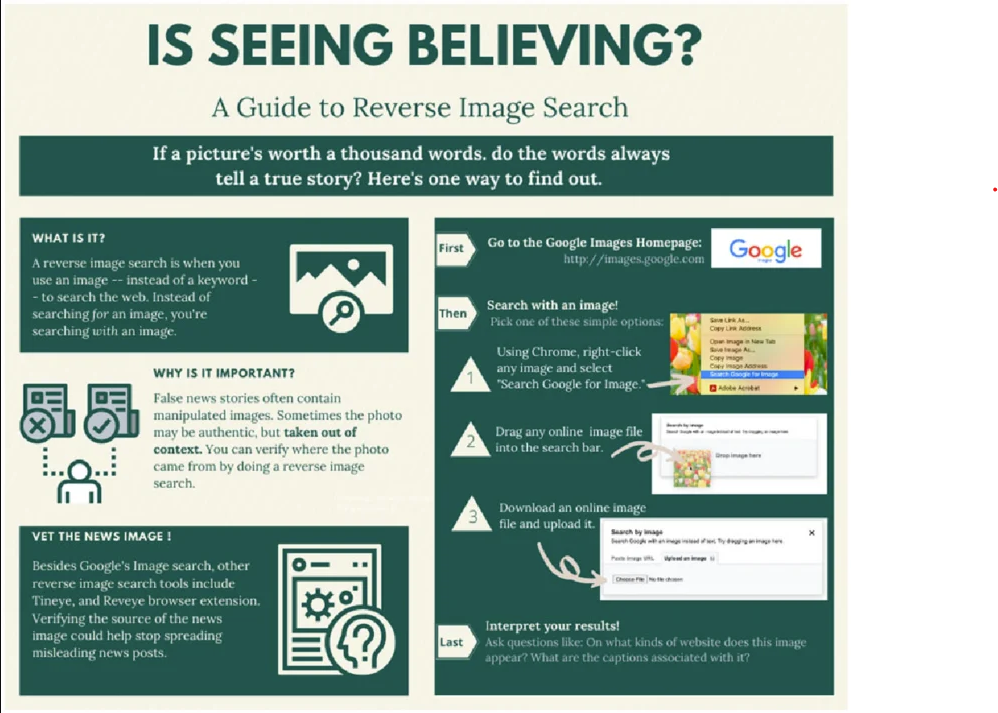
Media literacy skills take time to develop but can be helpful when faced with harmful content. Here are four media literacy skills you can keep in mind when consuming content:
- Learn to think critically.
- Evaluate media you consume and decide if messages make sense, why information was included or excluded, and what key ideas are in messages.
- Understand the authors’ goals.
- What does the author want you to take away from this piece of media?
- Is the media informative, is it trying to change your mind, or is it introducing new information that you have not heard of before?
- When we understand the type of influence content has, we can make informed decisions.
- Seek alternative viewpoints.
- Search for other content such as articles or sources on the same topic.
- If there are no results, or if you find contradicting information, you may want to continue fact checking or looking into new information.
- Share media responsibly.
- Damaging disinformation can spread quickly through shared posts.
- Review content you share for emotional and sensitive topics that may be used to manipulate readers into sharing without thinking.
When we practice media literacy we can reduce consuming content with violence or manipulative intent. Media literacy can also build resiliency, identify risk factors for violence, and promote safety among communities.
View additional resources and media literacy projects such as Media Literacy Now and the News Literacy Project for more information on how to stay informed while consuming content.
Reference: Qian, S., Shen, C., & Zhang, J. (2022). Fighting cheapfakes: Using a digital media literacy intervention to motivate reverse search of out-of-context visual misinformation. Journal of Computer-Mediated Communication, 28(1). https://doi.org/10.1093/jcmc/zmac024